Wednesday, February 24, 2010

My peeps


These are some of the real people I talk to in el parque central every day. From left to right, they are Mildred with her two niños, and Saida and Lilian. Not pictured are Ligla, Juliana, Carla, Lola, Lilia and Dorothy. The women are in traditional Mayan dress topped off with baby slings. Inside the baby slings are bead necklaces, tablecloths, table runners, potholders, and huipiles (traditional Mayan tops). But mostly necklaces. Usually one arm is loaded with necklaces, and when a potential customer walks by, they pull out the loaded arm to display their wares. Apparently they can spot a sucker a mile away, because they come running when they see me in the park. "Patty, you buy necklace?" And we proceed to look at the necklaces while we talk about our families, about the weather, about food--in Spanish! I'll admit I've purchased several necklaces, only the ones that I like, and only for about TWICE as many quetzales as they are worth. But you will not find Spanish tutors more willing or more patient than these dear ladies.   

Monday, February 22, 2010

First Sunday of Lent


We've seen a few church processions during our time here, but nothing like the one we saw yesterday. There were street decorations, floats, costumes, and a long somber march into town. Just enjoy the pictures.

Sunday, February 21, 2010

Buzz at Tikal


Posted by Buzz


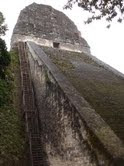
Once we decided to come to Guatemala for our winter getaway, I knew that one of the places I wanted to visit on our trip was Tikal. It’s a famous archaeological site for the Mayan civilization. If you know me, you also know that one doesn’t have to talk too long or hard to convince me to visit an archaeological site. Tikal is rated as one of the great archaeological sites in the world to visit. It’s a huge site with scores of monumentally large temples and buildings. A total of over 2,000 buildings, altars, and smaller installations such as storage pits have been found. 

Beyond that, I have a rather unusual connection to Tikal. Back in 1977, as a new Ph.D. student, I took a class in archaeological methods from a young professor named Dennis Puleston. He was a new world archaeologist who was working at Tikal, and after I took that course, I asked him to be on my Ph.D. oral committee because I really liked him. In the spring of 1978 he invited me to work on a project with his research by photographing the wear patterns on stone tools from Tikal using a scanning electron microscope. However, in the summer of 1978, while he was vacationing with his family, he was killed when he was struck by lightning while standing on the top of Chichen Itza, a large Mayan temple in Mexico. (See this link for a bio: http://www.mnsu.edu/emuseum/information/biography/pqrst/puleston_dennis.html)

So, as it happened, when I met my guide, Antonio, at Tikal, I asked him how long he had been at Tikal. He told me he grew up at Tikal and that his father had helped with the excavations that the University of Pennsylvania was doing back in the late 60’s and early 70’s. He told me that, as a kid, he played around Tikal all the time while his dad helped on the excavation. On a whim, I asked him if he happened to know Denny Puleston. “Oh yes,” he replied. “I remember him very well. He was one of the rising stars among the archaeologists working at Tikal.”  I smiled and said to Antonio, “I had Denny Puleston as a professor at the University of Minnesota.” He smiled, shook my hand, and we hit it off from that point.

Coming Soon: Part II (In the jungle at Tikal)


Friday, February 19, 2010

The power of a volcano


Antigua sits in a valley and is completely surrounded by mountains and volcanoes. The mountains are not snow-capped rockies but are green and furry like the ones where Juan Valdez lives.  I introduced you to the inactive volcano named Agua in the January 5 blog entry. When I sit on the roof of the language school, I can see both Agua and the active volcano Fuego (photographed here). Something happens to you when you gaze at these giants. You feel, at once, insignificant and essential. You become aware that much of the world is underground and that we are at the mercy of geological activity and laws of science that were set in motion when God started time. Then it hits you that you are a part of this creation, and you ask, "How am I so fortunate to be in this amazing place?" Then, of course, there comes a day when you start to take the volcanoes for granted. That is, until Fuego sends a billow of smoke into the air, or the ground shakes, or an old woman with a basket of chickens on her head smiles at me, and then I'm in wonderment again. 

Wednesday, February 17, 2010

Coconut Lemonade


It's a good thing!

This drink can be yours too if you go to La Peña de Sol Latino on 5a Calle, just two blocks from el parque central. We're going back for more.

Monday, February 15, 2010

Talking to real people


Esta mañana yo fui al parque central porque queria hablar español con la gentes. Yo compré algunas cosas al mercado: dos bolsas, dos manteles, y una mochila pequeña por mi nieto. Después yo fui al supermercado, compré pan y jugo de manzana. Yo caminaba en el parque y vi un hombre pobre. Yo le pregenté, "necesita el pan?" "Si," él dijo. Yo le di el pan y jugo de manzana. Él me pidío cinco quetzales. Yo dije que el pan es mejor. Después, yo hablé con una mujer se llama Soraida. Ella vendía las cosas de Antigua, pero yo no tenía mas dinero. Nosotros hablamos durante treinta minutos. (with apologies to seasoned Spanish speakers)

Translation: This morning I went to central park because I wanted to speak Spanish with the people. I bought several things at the market: two bags, two tablecloths, and a small backpack for my grandson. Then I went to the supermarket and bought bread and apple juice.  I was walking in the park and saw a poor man. I asked him, "Do you need bread?" "Yes," he said. I gave him the bread and juice. He asked me for 5 quetzales (money). I told him that bread is better. Later I talked with a woman named Soraida. She was selling souvenirs from Antigua, but I didn't have any more money. We talked for thirty minutes. 

Sunday, February 14, 2010

Las flores


Every weekday, around 3:30 a nice young man with a machete walks into the backyard of our casa, shimmies up the trees and prunes branches.

Then he cuts and stacks the wood in neat piles next to the house. He finishes by manicuring and watering the yard and all the plants in it. His name is Condido, and he lives nearby with his wife and kids. I've never seen anyone work as hard or as fast as he does. Keep in mind that his day starts early and he is responsible for ground maintenance in this complex of casas.  Here are some of the results of his labor. The orchids that spiral up the tree trunks are starting to bloom. The gold ones, only about an inch across, are called orquidia amarilla. The larger purple ones are called candelaria morada. We are sending these flowers to you for Valentine's Day.